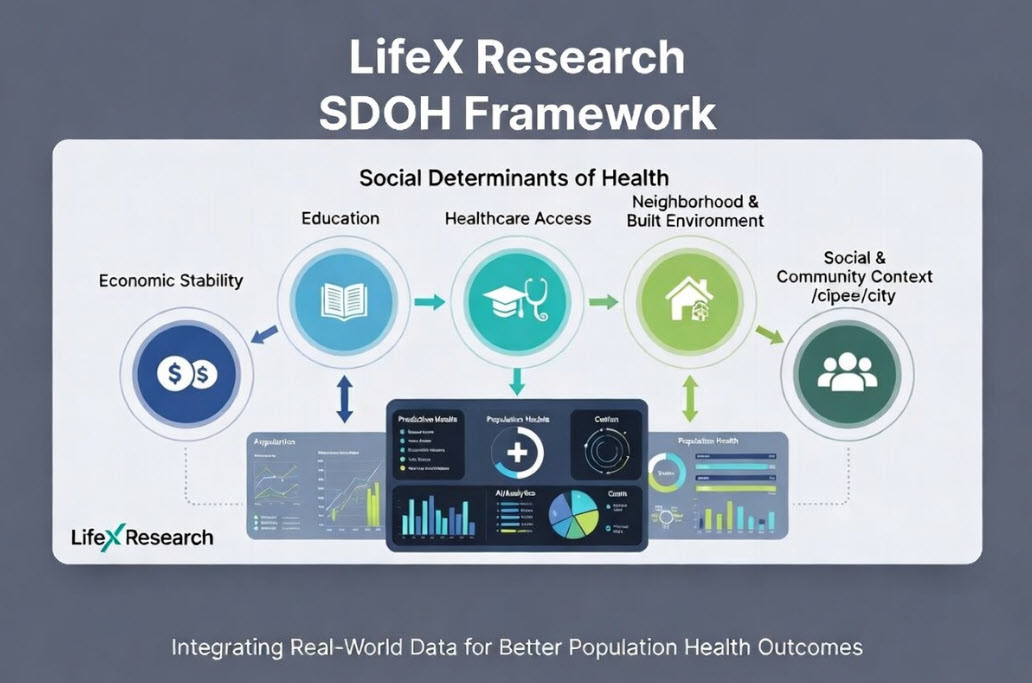
Atlanta, Georgia May 13, 2026 (Issuewire.com) In an era when healthcare costs continue to rise and chronic conditions affect workforce productivity, organizations seek deeper insights into the factors shaping population health. LifeX Research has integrated the Social Determinants of Health (SDOH) framework into its population health analytics platform.
This structured approach combines clinical and wellness data with environmental and social context to generate more accurate, actionable insights for employers, researchers, and healthcare stakeholders. The SDOH framework recognizes that health outcomes extend far beyond medical care by layering these determinants into predictive models.
Understanding Social Determinants of Health:
Social determinants of health encompass the non-medical conditions in which people are born, grow, live, work, and age. These include economic stability, education access and quality, healthcare access and quality, neighborhood and built environment, and social and community context. Public health authorities have long documented that these factors account for a significant portion of health disparities and outcomes across populations.
When applied to population health, the SDOH framework reveals patterns that traditional clinical data alone cannot capture. For example, limited access to nutritious foods or safe walking paths can directly influence metabolic markers and activity levels, while shift work schedules may disrupt sleep consistency and elevate stress-related biomarkers. LifeX Research incorporates these variables to create a holistic view of workforce health trends.
The Limitations of Traditional Population Health Analytics:
Conventional population health tools often rely solely on claims data, laboratory results, and self-reported medical histories. While valuable, these sources provide an incomplete picture. They overlook the daily realities that shape behavior and physiological responses. As a result, interventions may miss key drivers of poor health outcomes, leading to higher long-term costs and lower engagement rates.
LifeX Research addresses this gap through its Predictive Suite. The platform aggregates voluntary participant wellness data – including lifestyle habits, routine lab work, biometric entries, and health risk assessments – with external SDOH indicators. This integration enables early detection of risk signals and supports targeted recommendations tailored to real-world conditions.
LifeX Researchs SDOH Integration Methodology:
At the core of LifeX Researchs approach lies the systematic collection and analysis of real-world data from Research Associates. Participants voluntarily contribute lifestyle, lab, and wellness information within a compliant, privacy-protected environment. The Predictive Suite then enriches this dataset with SDOH variables such as commute length, local food access, neighborhood walkability scores, home responsibilities, and workplace culture factors.
Advanced analytics and predictive modeling process the combined dataset to identify emerging patterns. For instance, groups residing in areas with low walkability scores consistently demonstrate lower activity rates. LifeX Research uses this insight to adjust recommendations, suggesting indoor alternatives or micro-habit strategies that fit local infrastructure constraints.
Similarly, shift-based teams report irregular sleep schedules; the platform responds with customized evening routines that stabilize metabolic markers without requiring medication.
This methodology draws on interdisciplinary expertise in analytics, epidemiology, and public health. It transforms isolated data points into contextualized insights that empower proactive decision-making at both individual and population levels.
Real-World Impact on Workforce Health Outcomes:
Employers partnering with LifeX Research have observed tangible benefits from SDOH-informed insights. One analyzed cohort reduced stress-linked glucose spikes through simple evening routine adjustments derived from integrated data.
Another group achieved greater metabolic stability by addressing sleep inconsistency patterns linked to occupational demands. Claims data from these cohorts showed measurable improvements within the first year, including fewer sick days and enhanced employee focus.
By accounting for SDOH, LifeX Research helps organizations design wellness programs that resonate with diverse populations. Interventions become more relevant and achievable, increasing participation rates and long-term adherence. The result is a measurable reduction in chronic disease progression and associated healthcare expenditures.
Advancing Health Equity Through Data-Driven Insights
The SDOH framework naturally supports health equity initiatives. LifeX Researchs platform identifies disparities across demographic and geographic segments, enabling employers to allocate resources where they deliver the greatest impact. Predictive modeling highlights at-risk populations before clinical symptoms emerge, supporting preventive strategies that narrow outcome gaps.
This commitment aligns with LifeX Researchs broader mission to reduce healthcare costs for the American workforce while promoting sustainable population health improvements. The organization operates within a research-driven, compliance-focused framework that prioritizes data integrity, transparency, and ethical standards.
Future Directions for SDOH-Enhanced Population Health:
As AI capabilities and data sources continue to evolve, LifeX Research plans to deepen SDOH integration. Future enhancements will include refined geospatial mapping, real-time environmental data feeds, and expanded partnerships with public health entities. These advancements will further sharpen predictive accuracy and expand the platforms utility for researchers and healthcare organizations nationwide.
The application of the SDOH framework positions LifeX Research as a leader in proactive population health management. By moving beyond traditional metrics to embrace comprehensive, context-aware analytics, the organization delivers insights that drive meaningful change. Employers gain the tools to cultivate healthier, more resilient workforces, while communities benefit from evidence-based strategies that address the full spectrum of factors influencing well-being.
LifeX Research continues to demonstrate that effective population health insights require more than clinical data alone. The integration of the Social Determinants of Health framework represents a strategic advancement that delivers superior outcomes, cost efficiencies, and long-term value for all stakeholders involved in workforce wellness.
The Future of Workplace Wellness
Predictive health, powered by organizations like LifeX Research, is not a distant concept – it is active today. By shifting focus from treatment to prevention, employers can lower costs, boost productivity, and support genuinely healthier teams.
LifeX Research continues to refine its models through real-world data from thousands of Research Associates. The message is clear: the employers who succeed in 2026 and beyond will be those who embrace data-driven prevention alongside solid insurance coverage.
Ready to explore how predictive health can strengthen your employer-sponsored programs? LifeX Research offers the research foundation and analytical advantage to make proactive wellness a realty – without the complexity or conflicts of traditional models.
For more information, visit: https://lifexresearch.com/
Media Contact:
LifeX Research Corp.
Attn: Media Relations
Atlanta, GA
support@lifexresearch.com
Media Contact
RPR Comando, Steve Stanley
3055605786
1317 Edgewater Drive, Suite 5019, Suite 193
Source :LifeX Research Corp.
This article was originally published by IssueWire. Read the original article here.
