VANCOUVER, British Columbia, June 23, 2026 (GLOBE NEWSWIRE) — Miata Metals Corp. (TSXV: MMET) (FSE: 8NQ) (OTCQX: MMETF) (“Miata” or the “Company”) is pleased to announce additional drill results from its ongoing, 25,000 m diamond drilling program at its Sela Creek Gold Project (“Sela Creek” or the “Project”) in Suriname.
The 2026 drill program continues to advance Miata’s interpretation of Sela Creek as a large, structurally controlled gold system with multiple centres of gold mineralization. At Jons Trend, the deepest test of the mineralized zone completed to date successfully extended five known vein zones by 50 meters down-dip to a vertical depth of 250 m. The Company also discovered an additional zone below the formerly modeled gold mineralization. All of these vein zones remain open at depth. The drill hole returned a broad intercept across several vein zones of 63 m at 1.44 g/t Au. At Big Berg, continued step-out drilling returned both broad and higher-grade intercepts, 400 m to the southwest along strike from Jons Trend. Geological data continues to point towards the continuation of Jons Trend and Big Berg, in a single mineralized corridor of 1,300 m strike length.
Highlights:
- 26DDH-JT-016 extended Jons Trend to 250m vertical depth, confirming down-dip continuity across five known vein zones, discovering a deeper gold zone below the previous geological model
- Mineralization remains open at depth, with ongoing drilling testing the depth extent, continuity and potential strike extension
- 26DDH-JT-016 intersected:
- 63.0 m at 1.44 g/t Au from 167.0 m, including:
- 4.0 m at 1.85 g/t Au
- 4.0 m at 4.41 g/t Au
- 8.61 m at 2.48 g/t Au
- 4.50 m at 1.07 g/t Au from 16.5 m
- 5.29 m at 1.56 g/t Au from 265.0 m
- 63.0 m at 1.44 g/t Au from 167.0 m, including:
- 26DDH-BB-009 and 26DDH-BB-010 were drilled at approximately 20 m step-outs from mineralized intercepts in26DDH-BB-003 and 26DDH-BB-004, and extended the interpreted strike length and dip continuity of mineralized zones at Big Berg.
- 26DDH-BB-009 intersected:
- 7.2 m at 1.13 g/t Au from 104.3 m
- 33.0 m at 1.03 g/t Au from 149.5 m, including:
- 8.0 m at 2.91 g/t Au
- 26DDH-BB010 intersected:
- 9.25 m at 3.10 g/t Au from 71.0 m, including:
- 6.35 m at 4.17 g/t Au
- 9.25 m at 3.10 g/t Au from 71.0 m, including:
- 26DDH-BB-009 intersected:
- Results reinforce Jons Trend as a structurally controlled gold system that hosts repeating zones of mineralization which coalesce into broader mineralized zones at depth
- Drilling continues to define the potential connection between Jons Trend and Big Berg, which together may represent a broad mineralized corridor of approximately 1,300 m strike length
- Two drill rigs remain active at Sela Creek, with ongoing drilling at Jons Trend and Puma East
“JT-016 represents one of the most important holes drilled at Sela Creek to date,” said Dr. Jacob Verbaas, CEO of Miata Metals. “It successfully extended five known mineralized vein zones, identified a new deeper zone below our existing geological model, and returned a broad intercept of 63 m at 1.44 g/t Au. The hole increased the down dip extent by 50 m and the true vertical depth of the system to 250 m. The result demonstrates that the system continues to grow vertically and remains open for further expansion.”
“Big Berg also continues to deliver encouraging results and is increasingly demonstrating characteristics similar to Jons Trend, including repeating mineralized zones and strong continuity. Together, these results strengthen our view that Sela Creek hosts an expansive mineralized corridor with multiple centres of gold mineralization and significant room for continued growth.”
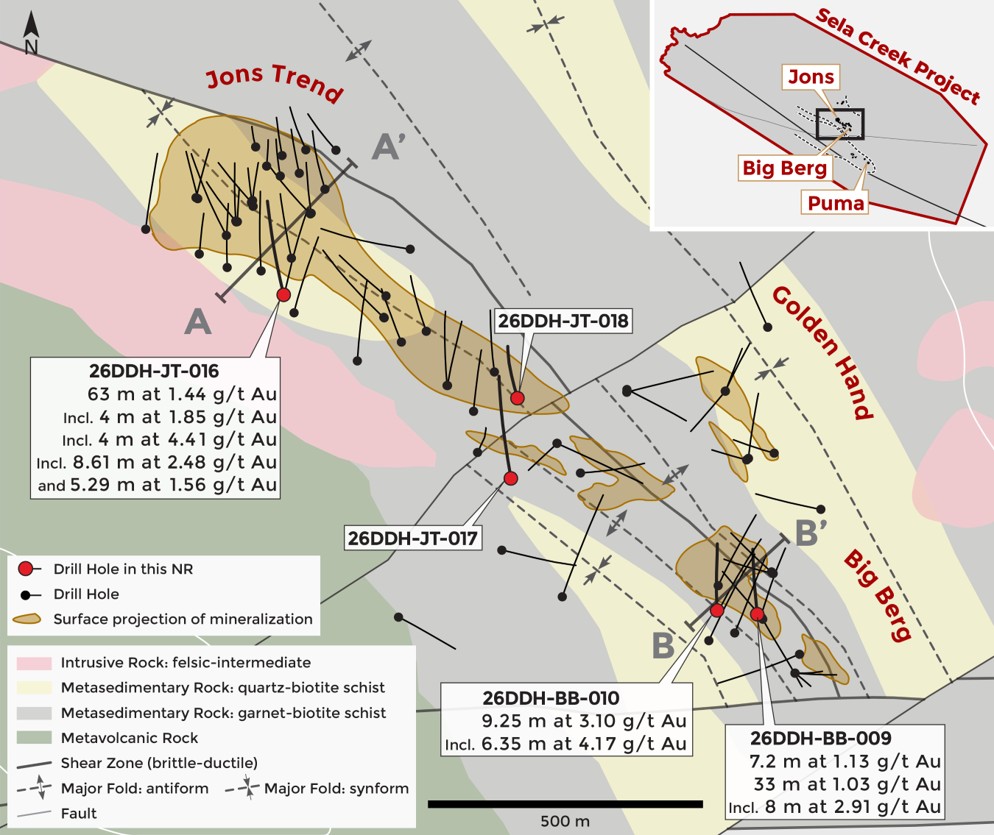
Figure 1. Plan view of Jons Trend and Big Berg with geological sections (Figures 2 to 3) lines indicated.
Jons Trend Drilling:
26DDH-JT-016 was designed to test the deepest portion of the Jons Trend system evaluated to date and extend gold mineralization to depth. The results are highlighted by a broad mineralized interval interpreted to represent the deeper projection of two thick vein zones that coalesce into a continuous mineralized intercept at depth:
- 63.0 m at 1.44 g/t Au from 167.0 m including:
- 4.00 m at 4.41 g/t Au, and
- 8.61 m at 2.48 g/t Au
- 2.80 m at 3.49 g/t Au
The broad intercept is interpreted to represent the down-dip convergence of multiple mineralized vein zones that were previously modeled as separate structures higher in the system. This observation supports the emerging geological model that individual mineralized zones and sub-parallel high-strain shear structures, may merge into broader mineralized envelopes at depth.
Drilling also intersected a newly identified deeper vein zone below the previous geological model:
- 5.29 m at 1.56 g/t Au from 265.0 m
This lower intercept occurs beyond the previous geological model and represents a new zone of mineralization at depth. In total, DDH-JT-016 is interpreted to have extended five existing vein zones down-dip and identified one new deeper zone, reinforcing the continuity and scale potential of Jons Trend. The mineralized zones remain open at depth, with ongoing drilling designed to further test the depth, continuity and potential strike extensions of Jons Trend.
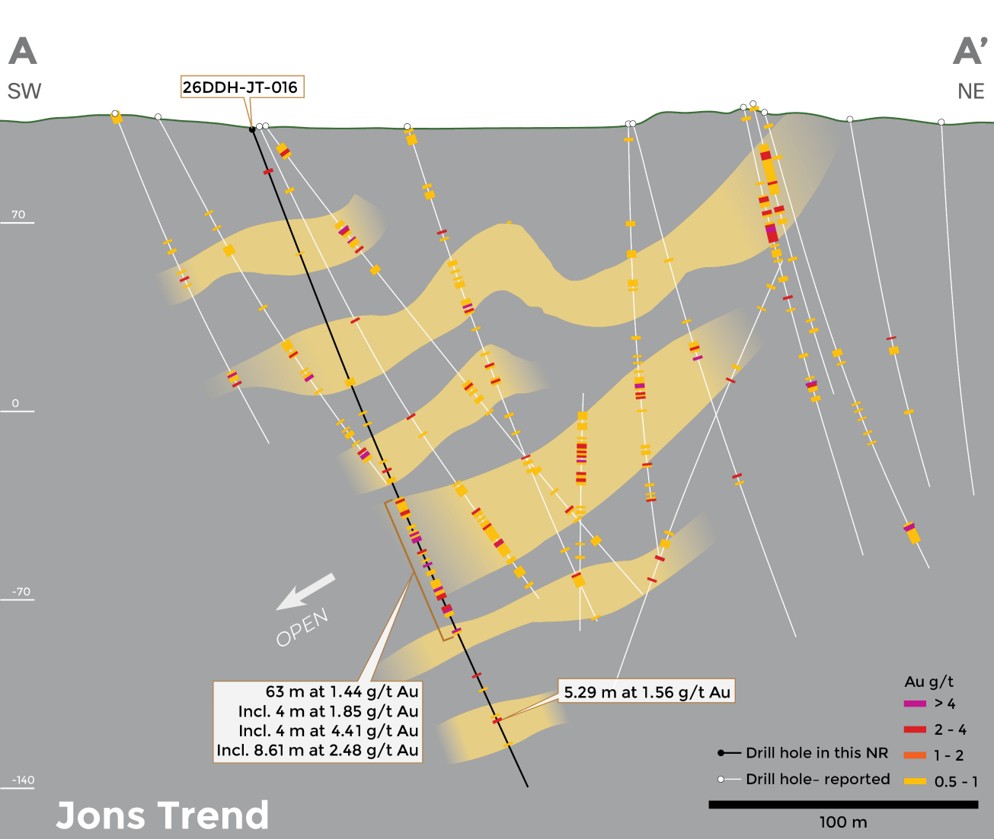
Figure 2. Cross section of central Jons Trend (A-A’ on Figure 1) showing 26DDH-JT-016 and the modeled vein zones. All vein zones remain open to depth.
Big Berg Drilling:
Big Berg continues to establish itself as a growing second centre of mineralization within the Sela Creek system. At Big Berg, holes 26DDH-BB009 and 26DDH-BB010 were drilled as approximately 20 m step-outs from previously reported holes BB-003 and BB-004. The holes were designed to test continuity along strike and down dip of the known mineralized vein zones.
Hole 26DDH-BB-009 intersected:
- 7.2 m at 1.13 g/t Au from 104.3 m
- 33.0 m at 1.03 g/t Au from 149.5 m, including:
- 8.0 m at 2.91 g/t Au
Hole 26DDH-BB010 intersected:
- 9.25 m at 3.10 g/t Au from 71.0 m, including:
- 6.35 m at 4.17 g/t Au
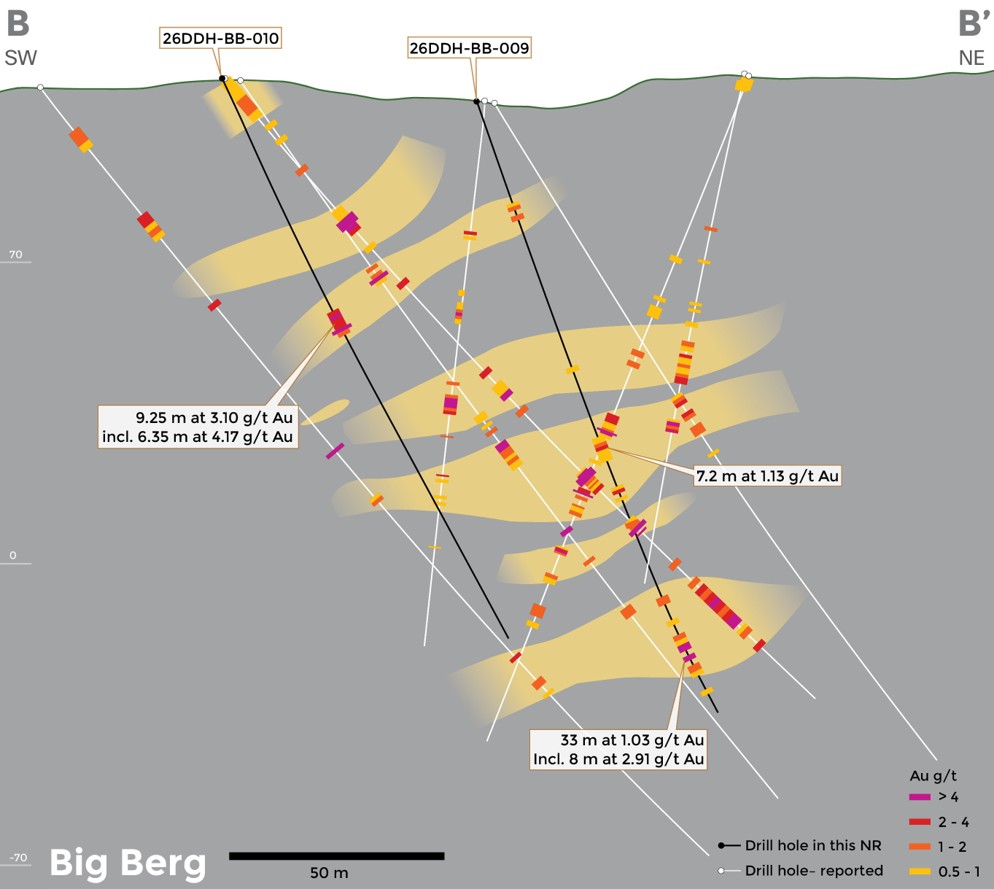
Figure 3. Cross sectional view of Big Berg (B-B’ on Figure 1) showing 26DDH-BB-009 and 010. Big Berg displays similar geological characteristics to Jons Trend.
Together, these holes demonstrate the range of mineralization styles developing at Big Berg. 26DDH-BB-009 highlights the potential for wider zones of gold mineralization and is characterized by folded veins and host-rock sulphides, while 26DDH-BB-010 demonstrates higher-grade mineralization over concentrated intervals associated with shear-hosted veining. Both holes display strong banded alteration, including silica, biotite, ± white mica and chlorite, consistent with the mineralization style observed at Jons Trend.
2026 drilling at Big Berg has intersected nine discrete mineralized zones in ten holes, supporting the interpretation of a robust and expanding mineralized system with significant potential for further growth. Miata continues to evaluate the potential connection between Big Berg and Jons Trend, with results to date supporting Big Berg as a growing parallel centre of mineralization within the same broader gold-bearing structural corridor.
To date in 2026, Miata has completed approximately 10,300 m of drilling across several targets at Sela Creek, including Jons Trend, Big Berg, Puma West, Puma East, Stranger, Cambior, and Golden Hand. Results remain pending for several recently completed holes.
Importantly, grades and widths have been maintained as the system expands vertically, providing increasing confidence in the continuity and scale potential of Jons Trend.
Table 1.Latest Gold Assay Results
| Hole Id | From (m) | To (m) | Intercept (m) | Au (g/t) | Target | true width (m) |
| 26DDH-JT-016 | 16.5 | 21 | 4.5 | 1.07 | Jons Trend | sap |
| and | 57 | 57.78 | 0.78 | 0.65 | 0.6 | |
| and | 111 | 117 | 6 | 0.75 | 4.9 | |
| and | 129 | 130 | 1 | 0.54 | 0.9 | |
| and | 134 | 136.4 | 2.4 | 0.67 | 2.3 | |
| and | 149 | 161.1 | 12.1 | 0.69 | 11.4 | |
| including | 155 | 156 | 1 | 2.09 | 0.9 | |
| and | 167 | 230 | 63 | 1.44 | 54.6 | |
| including | 169 | 170 | 1 | 2.69 | 0.9 | |
| including | 173 | 177 | 4 | 1.85 | 3.5 | |
| including | 184 | 188 | 4 | 4.41 | 3.5 | |
| including | 198 | 199 | 1 | 5.78 | 1.0 | |
| including | 205.39 | 214 | 8.61 | 2.48 | 8.3 | |
| including | 217.2 | 220 | 2.8 | 3.49 | 2.7 | |
| including | 228 | 230 | 2 | 2.94 | 1.9 | |
| and | 248.5 | 249.41 | 0.91 | 3.43 | 0.9 | |
| and | 254 | 256 | 2 | 0.58 | 1.9 | |
| and | 265 | 270.29 | 5.29 | 1.56 | 5.1 | |
| and | 278.21 | 281 | 2.79 | 0.60 | 2.7 | |
| 26DDH-JT-017 | 58.53 | 60 | 1.47 | 3.75 | Jons Trend | 1.2 |
| and | 170 | 171.5 | 1.5 | 0.58 | 0.8 | |
| and | 173 | 174.34 | 1.34 | 0.56 | 0.7 | |
| and | 183 | 184.5 | 1.5 | 0.59 | 0.8 | |
| and | 189 | 190.5 | 1.5 | 0.57 | 0.8 | |
| and | 193.5 | 197 | 3.5 | 1.15 | 2.2 | |
| including | 193.5 | 195.35 | 1.85 | 1.95 | 1.2 | |
| and | 206.32 | 207.5 | 1.18 | 0.69 | 0.8 | |
| and | 274 | 276 | 2 | 0.62 | 1.3 | |
| 26DDH-JT-018 | 24.55 | 25.55 | 1 | 0.60 | Jons Trend | 0.5 |
| and | 57.3 | 63.5 | 6.2 | 0.50 | 3.1 | |
| and | 105.3 | 109.6 | 4.3 | 0.62 | 2.5 | |
| including | 106.3 | 107.3 | 1 | 1.36 | 0.6 | |
| and | 140.5 | 143.5 | 3 | 0.51 | 1.9 | |
| and | 183.5 | 185 | 1.5 | 0.50 | 1.0 | |
| 26DDH-BB-009 | 35.5 | 40.5 | 5 | 0.82 | Big Berg | 4.7 |
| and | 83.5 | 85 | 1.5 | 0.67 | 1.4 | |
| and | 104.3 | 111.5 | 7.2 | 1.13 | 7.0 | |
| including | 107.1 | 108.1 | 1 | 3.53 | 1.0 | |
| and | 118 | 123.15 | 5.15 | 0.95 | 5.0 | |
| including | 120 | 121 | 1 | 3.05 | 1.0 | |
| and | 129.55 | 131 | 1.45 | 1.67 | 1.3 | |
| and | 149.5 | 182.5 | 33 | 1.03 | 29.9 | |
| including | 151 | 154.3 | 3.3 | 1.07 | 3.0 | |
| including | 163.5 | 171.5 | 8 | 2.91 | 7.3 | |
| 26DDH-BB-010 | 71 | 80.25 | 9.25 | 3.10 | Big Berg | 5.9 |
| including | 72.65 | 79 | 6.35 | 4.17 | 4.1 |
Table 2. Updated Collar Information.
| Hole ID | Easting* | Northing | Elevation (m) | Azimuth** | Dip | Length (m) |
| 26DDH-JT-016 | 754,832 | 418,085 | 106 | 348 | -55 | 300.17 |
| 26DDH-JT-017 | 755,245 | 417,751 | 113 | 353 | -48 | 278.62 |
| 26DDH-JT-018 | 755,257 | 417,897 | 114 | 350 | -65 | 210.30 |
| 26DDH-BB-009 | 755,693 | 417,504 | 112 | 355 | -53 | 188.60 |
| 26DDH-BB-010 | 755,620 | 417,511 | 112 | 355 | -48 | 177.42 |
All drill information is available through this link.
QAQC
Drill core samples are analyzed for gold at FILAB Suriname, a commercial certified laboratory under ISO 9001:2015. Samples are crushed and pulverized to 85% passing 88 µm prior to analysis using a 50 g fire assay (50 g aliquot) with an Atomic Absorption (AA) finish. For samples that return assay values over 5.0 grams per tonne (g/t) gold, another cut was taken from the original pulp and fire assayed with a gravimetric finish. Samples with coarse visible gold or returning an assay value over 10.0 g/t gold, metallic screen analysis is conducted on the coarse reject material. Miata Metals inserts certified reference standards, as well as blanks and ¼ core duplicates, in the sample sequence for quality control and assurance.
QP Statement
The scientific and technical information in this news release has been reviewed and approved by Dr. Jacob Verbaas, P.Geo., a director of the Company and Qualified Person as defined under the definitions of National Instrument 43-101 – Standards of Disclosure for Mineral Projects.
About Miata Metals Corp.
Miata Metals Corp. (TSX.V: MMET) is a Canadian mineral exploration company listed on the TSX Venture Exchange, as well as the OTCQX (OTCQX: MMETF) and Frankfurt (FSE: 8NQ) Exchanges. The Company is focused on the acquisition, exploration, and development of mineral properties. The Company holds a 70% interest in the ~215 km2 Sela Creek Gold Project with an option to acquire a full 100% interest in the Project, and a 70% beneficial interest in the Nassau Gold Project with an option to acquire 100%. Both exploration properties are located in the greenstone belt of Suriname.
On Behalf of the Board
Dr. Jacob (Jaap) Verbaas, P.Geo | CEO and Director
For Further Information, please contact:
Nikki McEachnie
Director of Investor Relations
nikki@miatametals.com
1-778-486-1500
Forward-Looking Statements
Certain information contained herein constitutes “forward-looking information” under Canadian securities legislation. Generally, forward-looking information can be identified by the use of forward-looking terminology such as “anticipates”, “anticipated”, “expected”, “intends”, “will” or variations of such words and phrases or statements that certain actions, events or results will occur. Forward-looking statements are based on the opinions and estimates of management as of the date such statements are made and are subject to known and unknown risks, uncertainties and other factors that may cause actual results to differ materially from those expressed or implied by such forward-looking statements or forward-looking information. Although management of the Company have attempted to identify important factors that could cause actual results to differ materially from those contained in forward-looking statements or forward-looking information, there may be other factors that cause results not to be as anticipated, estimated or intended. There can be no assurance that such statements will prove to be accurate, as actual results and future events could differ materially from those anticipated in such statements. Accordingly, readers should not place undue reliance on forward-looking statements and forward-looking information. The Company will not update any forward-looking statements or forward-looking information that are incorporated by reference herein, except as required by applicable securities laws.
Neither the TSX.V nor its Regulation Services Provider (as that term is defined in the policies of the TSXV) accepts responsibility for the adequacy or accuracy of this release
Photos accompanying this announcement are available at:
https://www.globenewswire.com/NewsRoom/AttachmentNg/652b1fc7-3086-4739-8f13-afb624886f15
https://www.globenewswire.com/NewsRoom/AttachmentNg/e4b814d8-20f0-4e86-b835-9425f79d1dd3
https://www.globenewswire.com/NewsRoom/AttachmentNg/8bfb4362-8c62-471c-85e3-1671b78613c9