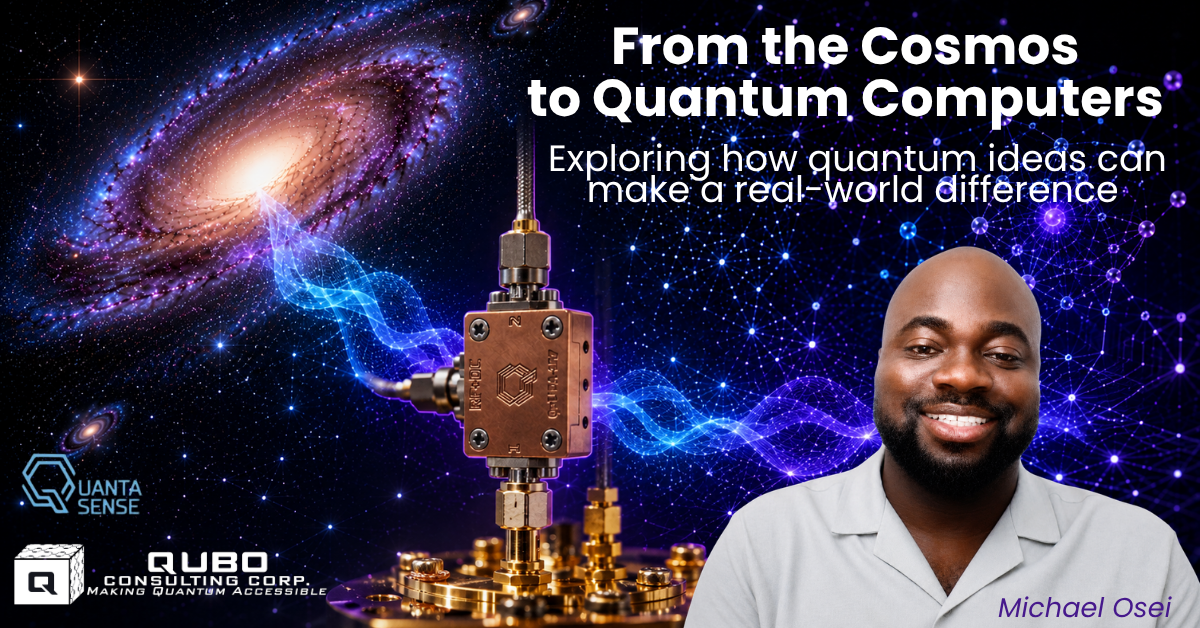
Michael Osei is interested in whether a quantum computer is fast but also does it produce reliable, high-quality, useful & cost-effective results?
CALGARY, AB, CANADA, August 4, 2026 /EINPresswire.com/ — Quantum technology can sound like science fiction: computers that solve problems beyond the reach of today’s machines, sensors that detect the almost undetectable, and discoveries that could reshape medicine, materials, energy, communications, and security.
But behind the headlines are researchers asking practical questions: What can quantum technology really do? When will it matter in everyday life? Which problems is it best suited to solve? And how do we ensure that promising discoveries become useful tools rather than remaining laboratory experiments?
Michael Osei is one of the researchers exploring those questions.
With an M.Sc. in Physics and research interests spanning neuroengineering, theoretical cosmology, and quantum computing, Osei brings a broad perspective to a field that is often misunderstood. Working through the Department of Physics and Astronomy at the University of Lethbridge, he is interested not only in the science behind quantum technology, but also in how quantum ideas can move from theory into meaningful real-world applications.
What is quantum technology?
Most of us use classical computers every day. Our phones, laptops, cars, banking systems, and household appliances all process information using bits, represented as either a zero or a one.
Quantum computers work differently. Their basic units of information are called qubits. Qubits can take advantage of the unusual rules of quantum mechanics, including superposition and entanglement. In simple terms, these properties may allow quantum systems to explore certain complicated calculations in ways that classical computers cannot efficiently match.
That does not mean quantum computers will replace ordinary laptops overnight. Many useful systems are expected to be hybrids: classical computers working alongside quantum processors. Classical systems can prepare data, control the process, and interpret results, while a quantum processor tackles a specialised part of a difficult calculation.
For Osei, that practical connection matters. He is interested in asking not only whether a quantum computer is fast, but whether it produces reliable, high-quality, useful, and cost-effective results. A technology is not valuable simply because it is new; it must solve a problem that matters.
From the early universe to tomorrow’s technology
Osei’s background in theoretical cosmology gives him a distinctive lens on quantum computing. Cosmology studies the universe at its largest scale: its origins, expansion, matter, energy, and the physical laws that shape everything around us.
At the earliest moments of the universe, conditions were extraordinarily hot, dense, and small. Under those extreme conditions, the familiar rules of classical physics are not enough. Quantum mechanics becomes essential.
Osei’s work has explored quantum cosmology and questions around thermalization; the process through which a system moves toward equilibrium. These questions connect to larger mysteries involving the early universe, dark matter, and dark energy.
That may seem far removed from quantum computing, but the same mathematical foundations run through both fields. Quantum mechanics is the common language. The equations used to understand particles, energy, and the early universe can also help researchers imagine new forms of computation.
It is a powerful reminder that research does not always move in a straight line. Ideas developed to understand the cosmos may one day help create better technologies on Earth.
Turning quantum ideas into useful tools
Osei’s interests reach beyond theory. He is especially focused on how quantum technology can address real-world problems.
One important area is quantum chemistry. Understanding how electrons move around atoms and molecules is vital for designing new materials, improving batteries, and developing medicines. These calculations can become extremely demanding for ordinary computers. Quantum computing may eventually help researchers simulate chemical systems more directly and efficiently, opening new possibilities for drug discovery, cleaner energy, and advanced materials.
Another area is quantum sensing. Quantum sensors can potentially detect signals with remarkable sensitivity. Osei has worked with QuantaSense on the theoretical design of superconducting quantum-limited amplifiers—devices intended to strengthen signals while adding as little noise as possible. This kind of work could support advances in sensing, communications, and technologies where extremely small signals matter.
Beyond speed: the test of usefulness
Quantum technology is often described as a race for speed. But speed is only one part of the story.
Osei emphasizes that quantum systems should be assessed through several practical tests. Can they produce results of high enough quality? Can they solve a meaningful problem better than a classical alternative? Can they operate reliably? Are they affordable enough to use at scale? Will they provide value to businesses, governments, researchers, and communities?
These questions are central to the future of quantum innovation. A powerful quantum device may be impressive in a laboratory, but its real impact depends on whether it can meet needs beyond the lab.
This is where collaboration becomes essential. Quantum technology is not only a physics problem. It brings together mathematics, computer science, engineering, chemistry, artificial intelligence, business, public policy, and education.
Why should curious people care?
Quantum technology is still developing, but its influence is already growing. Canada is building momentum through universities, research institutions, startups, and investments in quantum innovation. The field is creating opportunities for researchers, students, entrepreneurs, and people who are simply curious about the future.
For students and newcomers, Osei offers straightforward advice: take mathematics seriously – especially linear algebra. It is one of the foundations of quantum computing. Concepts such as vectors, matrices, eigenvalues, and eigenvectors may sound intimidating at first, but they are part of the language used to describe quantum systems.
Curiosity matters just as much. Quantum technology is a young field with plenty of unanswered questions and room for new ideas. It needs people who can think across disciplines, communicate complex concepts clearly, and connect scientific discovery with human needs.
Michael Osei’s work is a reminder that quantum technology is not only about the mysterious behaviour of tiny particles. It is about connecting bold scientific ideas to the challenges and possibilities of the real world.
For inquiring minds, that is what makes the quantum future worth watching!
Katanya Kuntz
Qubo Consulting Corp.
email us here
Visit us on social media:
LinkedIn
YouTube
Qubo Spotlight Interview – Meet Michael Osei!
Legal Disclaimer:
EIN Presswire provides this news content “as is” without warranty of any kind. We do not accept any responsibility or liability
for the accuracy, content, images, videos, licenses, completeness, legality, or reliability of the information contained in this
article. If you have any complaints or copyright issues related to this article, kindly contact the author above.

Media gallery