
Key Takeaways
- The Sales objective in Meta Ads Manager is the most effective choice for nonprofit donation campaigns because it trains Meta’s algorithm to find users most likely to complete a financial transaction – not just click or engage.
- Meta offers no special ad discounts for nonprofits; every campaign competes in the same auction as commercial advertisers, making creative quality and objective selection critical.
- Nonprofit Facebook ads averaged a median CPC of $0.39-$0.44 in 2025 – well below the platform average – but costs spike significantly in November, the most competitive giving season of the year.
- Running one focused goal per campaign keeps the algorithm sharp; mixing donation, volunteer, and awareness goals in a single campaign splits performance and dilutes results.
- The right audience data – donor lists, Custom Audiences, and 1-3% Lookalike Audiences – dramatically improves what the algorithm can do with any budget.
Choosing the right campaign objective is one of those decisions that looks minor but quietly controls everything downstream. For nonprofit marketing teams running donation campaigns on Facebook, that choice comes down to a single, somewhat counterintuitive answer: the Sales objective.
Meta’s Algorithm Rewards Transaction Intent – Even for Donations
Meta’s advertising algorithm is not a neutral delivery system. It is an AI-driven engine that reads historical account data, real-time user behavior, and campaign signals to decide who sees which ads – and when. The campaign objective selected tells the algorithm what kind of action to optimize for. Select Traffic, and it chases clicks. Select Engagement, and it chases reactions and comments. Select Sales, and it chases completed financial transactions.
That last behavior maps almost exactly onto online donation behavior. A donor navigating to a giving page, entering payment information, and confirming a contribution follows the same behavioral fingerprint as an e-commerce customer. Meta’s system does not distinguish between the two. It simply finds people who complete that action.
This is why objective selection matters so much for nonprofit fundraising. The algorithm reads transaction signals, and the Sales objective is the only one explicitly designed to chase them. GetHookd’s guide on Facebook ads for nonprofits covers this distinction in detail alongside real campaign examples and cost benchmarks worth reviewing before any campaign launch.
What the Sales Objective Actually Does
Meta simplified its Ads Manager from 11 objectives down to six: Awareness, Traffic, Engagement, Leads, App Promotion, and Sales. Sales sits at the bottom of the funnel – the only objective explicitly built to drive purchase-level conversions.
How Meta’s AI Identifies Likely Donors
Meta tracks user behavior across its platforms and the broader web through the Meta Pixel, cookies, in-app activity, and device signals. Over time, this builds a behavioral profile for each user. The Sales objective feeds a campaign into a segment of users whose profiles match a pattern of completing online financial transactions – people who have actually followed through, not just browsed.
This targeting precision is the core advantage. Instead of serving ads broadly to anyone who might care about a cause, the algorithm narrows delivery to people with demonstrated follow-through behavior. That is a fundamentally different audience than what Traffic or Engagement campaigns reach.
Why Traffic and Engagement Objectives Fall Short
Traffic campaigns optimize for link clicks. Engagement campaigns optimize for likes, shares, and comments. Both can generate activity, but neither signals anything about willingness to complete a transaction. For donation campaigns, that activity gap is expensive – it fills reports with vanity metrics while the actual conversion rate stays flat. Switching to Sales does not guarantee donations, but it ensures the algorithm is pulling from the right pool of users from the start.
No Nonprofit Discount: Competing in the Same Auction
Unlike Google, which offers a dedicated Ad Grant program for eligible nonprofits, Meta provides no grants, subsidies, or reduced rates for charitable organizations. Every nonprofit campaign competes in the same real-time auction as retailers, app companies, and direct-to-consumer brands. That is not a reason to avoid the platform – it is a reason to be strategic about every dollar spent on it.
The upside: nonprofit campaigns historically see lower CPCs than most commercial industries. The downside: that cost advantage is not permanent, and it disappears fast when campaigns run weak creative against untested audiences with no clear objective signal guiding the algorithm.
One Campaign, One Goal
This is one of the most consistently violated principles in nonprofit paid social – and one of the most consequential.
Why Mixed Goals Compromise the Algorithm
Meta’s algorithm optimizes within the boundaries of a campaign’s objective. When a campaign tries to drive both donations and volunteer sign-ups, the algorithm receives conflicting feedback signals. It cannot simultaneously optimize for two different behavioral patterns. The result is a campaign that does neither particularly well, burning budget without a clear performance story to learn from.
Donation, Volunteer, and Awareness Campaigns Belong Separate
Each campaign type belongs in its own structure:
- Donation campaigns – Sales objective, conversion-focused landing page, financial transaction as the target action
- Volunteer recruitment campaigns – Leads objective, Instant Forms or sign-up page, form submission as the target action
- Awareness campaigns – Awareness or Engagement objective, video views or reach as the metric, with retargeting to follow
Separating these gives each campaign a focused algorithm, a clean data set, and a measurable outcome. It also makes it immediately clear which campaigns are performing and which need adjustment – instead of trying to diagnose a muddled result from a mixed-goal setup.
What Nonprofit Facebook Ads Actually Cost
Cost benchmarks provide useful planning anchors, though actual results vary by creative quality, audience targeting, and campaign timing.
$0.39-$0.44 Median CPC – And When That Spikes to $0.54
Nonprofit Facebook campaigns averaged a median CPC of $0.39 in 2025, with a range running from $0.28 in January to a Q4 high of $0.54 in November. That November spike is driven by retail advertisers flooding the auction during the holiday shopping season – which happens to overlap with one of the most important giving windows of the year for nonprofits.
Organizations planning a year-end fundraising push should front-load audience-building in Q2 and Q3. Warming up an audience before November with awareness content significantly reduces the cost of converting that audience when the donation campaign goes live.
Average CPA of $96.55 and How to Beat It
The average cost per acquisition (CPA) for nonprofit Facebook campaigns sits at approximately $96.55, reflecting the longer decision cycle associated with charitable giving. That number shifts substantially based on three variables: creative quality, audience precision, and landing page conversion rate.
Campaigns that consistently beat this average share common characteristics – strong creative tested in multiple formats, audiences built from real donor data, and a retargeting layer that re-engages people who visited the donation page without completing a gift.
Creative That Converts: What the Algorithm Learns From
Creative performance directly shapes what the algorithm learns. Every interaction – click, scroll-past, video view, donation – feeds the system. Strong creative accelerates learning; weak creative teaches the algorithm to chase the wrong signals.
Impact-First Copy and Specific Dollar Amounts
Copy that opens with a specific, tangible outcome consistently outperforms copy built around organizational history or general mission statements. “$25 feeds a child for a week” gives a prospective donor a clear mental transaction to evaluate. “Support our mission to end hunger” asks them to do all of that work themselves.
Real photos of program beneficiaries outperform polished stock imagery. Specific donation goals tied to real outcomes outperform vague asks. A direct “Donate Now” CTA leading to a mobile-optimized donation page outperforms any multi-step friction point between the ad and the giving form.
Run 7-14 Days Before Drawing Conclusions
Meta’s algorithm requires a learning period to optimize delivery effectively. Running a campaign for fewer than seven days typically means pulling the plug before the system has gathered enough data to make accurate targeting decisions. A minimum of 7-14 days allows the algorithm to test delivery patterns and shift spend toward the highest-performing audience segments. Making major changes before that window closes tends to reset the learning phase and extend the inefficiency period.
Research Before You Spend
Two research tools should inform any nonprofit campaign before a single dollar is spent. The Meta Ad Library is a free, publicly accessible database showing every active ad running on any Facebook Page. Reviewing long-running ads from similar organizations is one of the fastest ways to understand which creative formats and copy structures are already resonating with a shared audience – ads that have run for extended periods are almost always a performance signal, not an oversight.
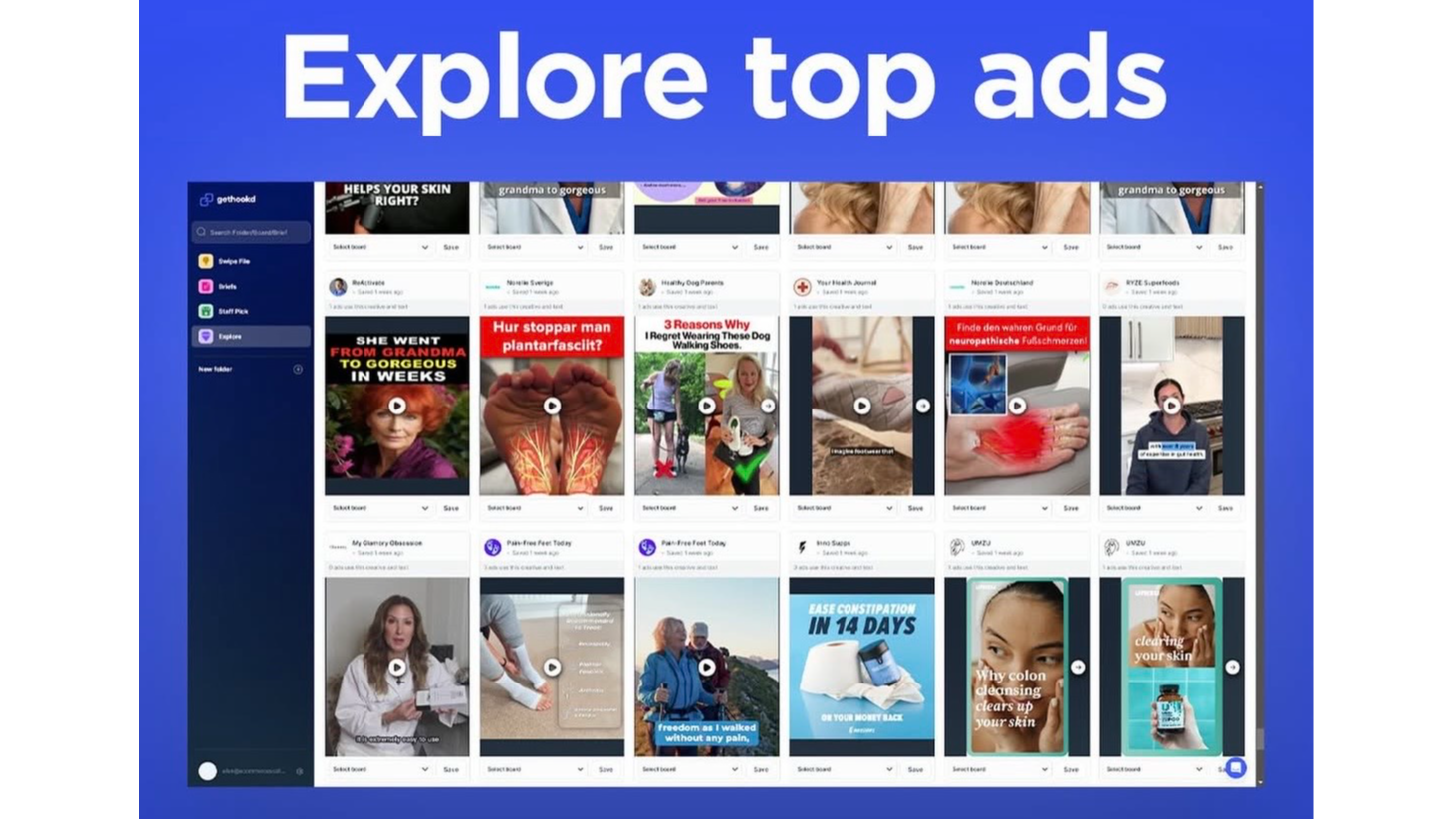
For teams that want to go deeper, tools like GetHookd extends that research capability with performance scoring, brand spy competitor intelligence, and AI-powered creative tools – pulling from a database of 65M+ analyzed Meta ads. Instead of building campaigns from scratch, marketing teams can identify what similar organizations are actively scaling, clone proven ad structures, and produce creative variations in minutes.
Set the Sales Objective – Then Let the Algorithm Work
The Sales objective is the correct tool for donation campaigns because it aligns the algorithm’s optimization target with the exact behavior nonprofits need: a completed financial transaction. Everything else – audience quality, creative performance, campaign structure, timing – determines how efficiently the algorithm can reach that goal once the right objective is set.
The organizations that consistently outperform sector averages are not necessarily the ones with the largest budgets. They are the ones running single-goal campaigns, feeding the algorithm real donor data, testing creative before scaling, and giving the system enough time to actually learn. That combination – clear objective, quality inputs, disciplined patience – is what separates campaigns that raise money from those that just run ads.
GetHookd LLC
40 SW 13th street
902
Miami
Florida
33130
United States


